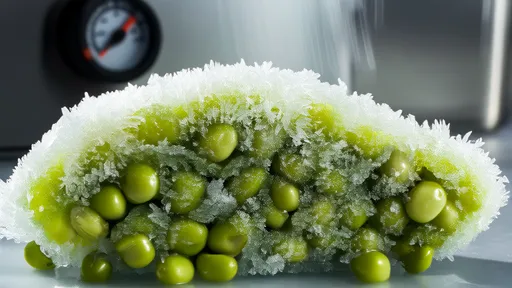
The concept of glass transition in frozen foods has long fascinated food scientists and industrial processors alike. Among the various vegetables subjected to quick-freezing techniques, green peas stand out as a particularly interesting case study. When exposed to ultra-low temperatures around -30°C for approximately 15 minutes, these vibrant legumes undergo a remarkable molecular transformation into what researchers call the "glassy state." This phenomenon represents far more than just another industrial freezing parameter—it's a delicate dance between water molecules and cellular structures that determines final product quality.
Deep freezing at -30°C creates conditions where the remaining unfrozen water in green peas achieves extremely high viscosity, effectively becoming an amorphous solid without crystalline structure. The 15-minute window represents a critical threshold where the vegetable's internal matrix transitions into this metastable glassy phase while preserving cellular integrity. Unlike conventional freezing which allows damaging ice crystals to form, this rapid thermal treatment locks the peas' moisture into a stable, non-crystalline state that better maintains texture and nutrients during storage.
Industrial applications of this technique reveal surprising complexities. The precise -30°C temperature isn't arbitrary—it sits just below the reported Tg' (glass transition temperature of maximally freeze-concentrated solution) for green peas. Maintaining this thermal environment for exactly 15 minutes allows sufficient heat transfer through the pea's spherical geometry without causing excessive dehydration. Process engineers have found that even slight deviations in either temperature or duration significantly impact the percentage of achieved glassy state, with corresponding effects on product shelf life and quality.
Microstructural analysis shows why this specific treatment works so well for peas compared to other vegetables. The peas' naturally high sugar content and particular starch composition create an ideal biochemical environment for glass formation at these parameters. When flash-frozen under these conditions, electron microscopy reveals an amorphous matrix where water molecules become immobilized within the dense carbohydrate network. This explains the remarkable preservation of texture—the peas maintain their characteristic "pop" when thawed and cooked, unlike the mushy consistency resulting from conventional freezing methods.
Commercial implications of this technology extend beyond simple preservation. Food manufacturers utilizing the -30°C/15min protocol report significantly reduced drip loss during thawing—a critical factor for both quality and economics. The glassy state effectively "traps" volatile flavor compounds that would otherwise degrade or evaporate during frozen storage. This explains why properly treated frozen peas can surprisingly outperform off-season "fresh" peas in sensory evaluations, maintaining brighter color and sweeter flavor profiles for up to 18 months.
Recent advances in cryogenic technology have made this precise freezing protocol more accessible to medium-scale processors. Modern spiral freezers with precise thermal zoning can now maintain the required -30°C environment while handling throughputs exceeding 5 tons per hour. Some innovative systems combine fluidized bed initial freezing with final stabilization in static cold air, achieving the glass transition more consistently than older tunnel designs. These technological improvements have helped transform what was once a laboratory curiosity into a commercially viable standard for premium frozen vegetable products.
The environmental aspects of this freezing method present an interesting paradox. While achieving -30°C requires more energy than conventional -18°C freezing, the extended shelf life and reduced food waste often result in lower overall carbon footprint. Life cycle assessments demonstrate that the energy investment in deeper freezing pays dividends through reduced transportation losses and longer storage capability at distribution centers. Some sustainability-focused producers have begun pairing this technique with renewable energy-powered freezing facilities, creating frozen vegetable products with remarkably low environmental impact.
Looking ahead, researchers are exploring how variations in pea cultivars might optimize this process further. Early results suggest certain high-sugar pea varieties may achieve stable glassy states at slightly higher temperatures (-25°C to -28°C), potentially offering energy savings without quality compromise. Other studies investigate whether slight pre-treatment modifications—such as brief blanching times or specific cooling rates before freezing—could enhance the glass formation process. As understanding of plant cryobiology deepens, the humble green pea continues to serve as both a model system and a beneficiary of advanced food preservation science.
By /Jul 17, 2025
By /Jul 17, 2025
By /Jul 17, 2025
By /Jul 17, 2025
By /Jul 17, 2025
By /Jul 17, 2025
By /Jul 17, 2025
By /Jul 17, 2025
By /Jul 17, 2025
By /Jul 17, 2025
By /Jul 17, 2025
By /Jul 17, 2025
By /Jul 17, 2025
By /Jul 17, 2025
By /Jul 17, 2025
By /Jul 17, 2025
By /Jul 17, 2025
By /Jul 17, 2025
