The delicate balance of mayonnaise hinges on a precise emulsion of oil and water. When this equilibrium falters, the smooth, creamy texture gives way to a greasy, separated mess. Understanding the critical oil ratio that triggers this breakdown reveals the fascinating science behind one of culinary’s most temperamental creations.
The Chemistry of Emulsion
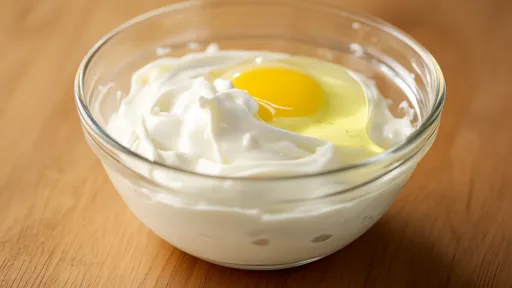
Mayonnaise is a classic example of an oil-in-water emulsion, where tiny droplets of oil are suspended in a water-based liquid (typically vinegar or lemon juice). Egg yolk acts as the emulsifier, its lecithin molecules forming a protective layer around each oil droplet to prevent coalescence. This stabilization is what gives mayonnaise its signature thickness and sheen. However, like all emulsions, mayonnaise exists in a fragile state—push the oil content too far, and the system collapses.
The Breaking Point
Research suggests that most traditional mayonnaise recipes stabilize at oil concentrations between 65% and 80%. Beyond this threshold, the emulsifying capacity of the egg yolk is overwhelmed. With insufficient lecithin to coat the expanding surface area of oil droplets, the emulsion destabilizes. The oil phases separate, rising to the surface in an unappealing slick. This critical ratio isn’t absolute—factors like emulsifier strength, mixing technique, and temperature influence the exact breaking point—but it serves as a warning line for both home cooks and industrial producers.
Industrial vs. Homemade: A Matter of Margin
Commercial mayonnaise often pushes closer to the 80% oil mark, leveraging industrial homogenization equipment and stabilizers like xanthan gum to maintain cohesion. Home recipes, relying on manual whisking and natural lecithin, tend to cap at 75% for safety. The difference highlights an intriguing trade-off: while higher oil content delivers richer mouthfeel, it demands more precise control. A single extra tablespoon of oil in a homemade batch can tip the scales from creamy to catastrophic.
Rescuing a Failed Emulsion
When mayonnaise "breaks," all is not lost. The separation is reversible if caught early. Slowly introducing the curdled mixture into a fresh egg yolk (a new source of emulsifier) while whisking vigorously can often rebuild the emulsion. This trick exploits the same principle as the original recipe—providing enough lecithin to coat the oil. Prevention, however, remains preferable. Gradual oil addition during initial emulsification allows the yolk to properly incorporate each droplet before the next arrives.
Temperature’s Hidden Role
Oil viscosity changes with heat, altering its behavior in emulsions. Cold oil is thicker, forming larger droplets that strain the emulsifier’s capacity. Room-temperature ingredients blend more smoothly, distributing the oil in finer droplets that are easier to stabilize. This explains why many recipes insist on taking eggs and vinegar out of the refrigerator hours before mixing. The lesson extends beyond mayonnaise—emulsion science underpins everything from salad dressings to pharmaceutical creams.
Beyond the Kitchen: Emulsions in Nature and Industry
The principles governing mayonnaise apply far beyond condiments. Milk, butter, and even crude oil spills involve similar oil-water interactions. Industrial applications—from cosmetics to pesticides—rely on controlling emulsion stability. In each case, identifying the critical breaking point determines product success. Mayonnaise, then, serves as both a culinary staple and a miniature laboratory for studying interfacial chemistry.
The next time your mayonnaise splits, remember: you’ve witnessed a precise scientific boundary in action. That glossy jar on your shelf represents not just good cooking, but a triumph over one of nature’s trickiest physical balances.
By /Jul 17, 2025
By /Jul 17, 2025
By /Jul 17, 2025
By /Jul 17, 2025
By /Jul 17, 2025
By /Jul 17, 2025
By /Jul 17, 2025
By /Jul 17, 2025
By /Jul 17, 2025
By /Jul 17, 2025

By /Jul 17, 2025
By /Jul 17, 2025
By /Jul 17, 2025
By /Jul 17, 2025
By /Jul 17, 2025
By /Jul 17, 2025
By /Jul 17, 2025
By /Jul 17, 2025
